In typical American society today, extroversion is favored over introversion. Extroverts are viewed as more successful because they are considered outgoing, popular, and adventurous. While an introvert may still have these qualities, they are viewed as less successful since they would like to be on their own sometimes. This is all explained in Introvert Power, by Laurie Helgoe. Introversion, personality and desire, are Helgoe’s speciality in her writing and psychology. She wrote this book to go against the norms and explain that introversion is ok. Each section of the book is teaching introverts, or extroverts who would like to understand, different aspects of being an introvert, why it is frowned upon in society, and why it really is a gift to those who are introverted. To prove this Helgoe explains many different scientific studies. One she cited was done by Maya Tamir, director of the Emotion and Self-Regulation Laboratory at Boston College and Hebrew University. The study had different extroverts and introverts try to complete an “effortful task.” in their efforts, the extroverts tried to make it more enjoyable. For the introverts, trying to seek happiness made completing the task harder and so they tried to avoid any emotional stimulation. Although this may seem like a bad thing, it showed that the introverts in this study were more likely to complete their task faster or more efficiently. Helgoe also used personal narratives to explain that introversion is not a bad thing. She explains a feeling that is probably very relatable to every introvert. After a long day she goes to dinner with a few of her friends, “the women were exuberant, excited, and exhausting...I kind of wanted what they were having. They seemed to be having so much fun!...What was wrong with me? I wasn’t sharing any of these good feelings!” (73 helgoe). After the anecdote, she explains that this is a normal feeling. She creates a sense of belonging to every introvert who feels they are broken. I believe her purpose was achieved in this book so far. I had always wanted to be extroverted because that seemed better and easier, but now I’m not afraid to be who I am.
Sunday, September 27, 2015

Sunday, September 20, 2015
TOW #2- Glad Advertisment
This advertisement is meant to make its viewers do a double take. At first they will see nothing wrong, then it hits them. This visual text shows what appears to be a watermelon, but it instead has red meat on the inside. The argument is that if the watermelon were to have been covered in Glad Cling Wrap, it would still be a watermelon. Glad is a very popular choice for household items such a cling wrap or trash bags. The ad was created by DDB ad agency which is owned by the world’s largest advertising holding company. The problem Glad found, is if food is let out it will start to spoil and will taste bad, to prevent this it must be taken care of a certain way. This ad was clearly produced in order to convince consumers to buy this cling wrap in order to protect their food’s taste. Adult consumers are the people more drawn to this ad as they are typically the ones shopping for these types of products. To prove their point, Glad used symbolism to portray a watermelon, but actually showed red meat. They’re not really depicting red meat but they used it in the image in place of watermelon to show what the watermelon would basically become without the cling wrap. Hyperbole is also used as a watermelon will not literally turn into meat or have such a drastic change in taste. This advertisement requires its audience to assume some information. It is not stated why the watermelon is meat, once the text at the bottom is read it is inferred that the watermelon is portrayed that way because it no longer tastes as it should. I believe their purpose was achieved. The ad looks disgusting; it makes me uneasy. Now whenever I see food sitting out without anything to protect it I will picture this ad and will be grossed out by the food.
Wednesday, September 16, 2015
TOW #1- The Healing Power of Hugs
http://opinionator.blogs.nytimes.com/2015/09/01/the-healing-power-of-hugs/?_r=0
No one can deny in times of stress, a hug has the ability to make anyone feel better. Hilary Jacobs Hendel, an experienced therapist, noticed this after hugging one of her patients. After the hug, her patient told Hendel that she felt cured from her life long depression. Because of this, Hendel became curious about the actual healing powers of a hug, and if it should be more popular as a tool in therapy sessions. She wrote this article to explore these thoughts for other therapists or anyone who was curious about hugs and hugs in therapy. To decide on whether or not she believed hugs should be involved in therapy, she started the article with personal narratives. She included the one about her patient who claimed to be cured. Hendel also explained how instead of continuing to hug her, she instead had that patient picture being hugged in her head. Maybe picturing a hug would have the same effect as an actual hug. Hendel also decided to check factual sources to see if hugging was stated to not be allowed in therapy or not. She checked the ethical guidelines from the National Association of Social Workers and the American Psychological Association and it was found that it is never stated that a therapist cannot hug their patient. So although it was mainly known to be taboo, it was legal. In the end, Hendel decided that hugs were not a good idea to use in therapy. She writes, “So even when I think a physical hug would be therapeutic, I continue to rely on fantasy (Hendel).” I don’t believe she accomplished her purpose of proving that. Only in the very last paragraph does she state that opinion. She does not give good reasons for why she believes that. The whole article was Hendel debating either side, so there were good things and bad things to each side, there is nowhere her opinion is favored.
Tuesday, September 15, 2015
IRB Intro Post #1
The book I chose to read this quarter is "Introvert Power" by Laurie Helgoe. I chose this book because I am interested in how and why people think and act, introversion and extroversion are a big part of that. I am an introvert and would like to learn more about how to deal with the downsides of being one. I have heard this book is a big help for other introverts.
Sunday, August 30, 2015
The Ethics of Living Jim
In times today, it is not common to see people call someone sir in order to be formal. In Richard Wright’s time, it was the only way. Wright was an author known for his controversial writings about african american struggles of his time. He wrote The Ethics of Living Jim Crow: An Autobiographical Sketch, which is an essay describing different points in time where Wright struggled with racism. It begins with him being a child in a “war” with the white kids from a different neighborhood. He is disadvantaged and gets hurt, so his mother tells him not to fight with white kids anymore. Once he grows older he tries to find a job. His two coworkers don’t like the fact Wright works with them. They accuse him of not addressing them with a proper Sir. He had to leave the job completely so he wouldn’t be beaten by them. He wrote all of these horrible memories down so people who did not experience what he did, will know what it was really like to be black in his times. He also wanted to explain the black people’s perspective on this. To explain, he quotes one of his friends, “Lawd, man! Ef it wuzn’t fer them polices ‘n’ them ol’ lynch-mobs, there wouldn’t be nothin’ but uproar down here!(170)” This quote explains they are in such a bad situation they are even thankful for abusive policemen and lynchings. If it weren’t for them, everyday white people would be abusing and murdering them publicly. The personal narrative perspective really affected the reader in this essay. Whenever Wright was scared it made the reader scared and feel what he felt. This essay is split into different little numbered stories. All of the stories are very different, in length, amount of dialogue, and plot. Because one story may be much longer than another, this shows how much even a little life event can affect someone entirely.
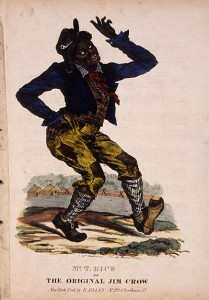
Thomas D. Rice shown in his black face costume, highly influential in Jim Crow issues
Source: Edward Williams Clay (1799-1852), published by E. Riley, New York
Living With Daughters
Straightening naturally curly hair is a long, painful, and difficult procedure. Even so, standards of beauty in pop culture have been trying to convince women to straighten their natural hair for a long time. Someone who knows this well is Gerald Early, an award winning author who is a professor of African American studies. He wrote Living with Daughters: Watching the Miss America Pageant to explain how black women felt when surrounded by mostly white women in pop culture. They were unable to find role models in the media which made it harder to find themselves. It was written for anyone who wanted to understand the oppression black women dealt with. To tap into the real feelings of a woman, Early went to his mother, wife, and daughters. Early would ask his daughters how they felt about their beauty, “I asked her if she would like to have her hair straightened.(539)” He would analyze his daughter’s answers to see how they were reacting to his parenting styles and how their peers treated them. He also references studies done to show that black children prefer a white doll as opposed to a black doll because it is “prettier.” From this he explains how this affects his life through personal narrative. Early’s wife does not buy their children white dolls. This is her defense system against the issues Early is writing about. It seems to work as their children are comfortable with who they are and find things like beauty pageants “silly”. Early’s family always watches beauty pageants and his children find it funny that women would try so hard to be liked. Although his mother believes it is important to have a black women win it to lead as a role model, Early’s children do not even notice. Instead of getting their hair straightened, Early and his wife decided to give their daughters traditional afros. Although their peers initially made fun of them, they learned to love it and themselves.

Vanessa Williams, the first black beauty pageant winner, surrounded by three white women
source: newsone.com
Illumination Rounds
No one knows war as well as someone who served in it. No one can explain their own experiences like a writer. Clearly the best person to write about their times in war would be a soldier and an author, like Michael Herr. He wrote Illumination Rounds which is made up of several personal stories of his service in Vietnam. The Vietnam War started in 1955 and was a conflict between the US and Vietnam. The stories in his essay range from his helicopter being shot as he watched his fellow soldier die, to getting high with his friends. The contrast between these two types of events really shows how crazy war was for him. He had an interesting experience no one else had. This was written to inform people who were never in a war what battle is actually like. Not only is it terrifying, like when he saw a little girl’s leg detached next to her, but it can also be funny, like when an angry soldier tricked a Chaplain. The fact this was written in a narrative form really gave the reader the feeling of being there himself. It made it clearer to imagine Herr’s experience. The dialogue also helps with this; It is written differently in this essay than in other texts. Correct grammar or spelling is not used. A man Herr was talking to said, “You git up onna ridgeline, see y’keep yer head down. Y’heah?( Herr 336)” This is to show how the people Herr interacted with actually talked and what it sounded like to him. It gives the passage a more realistic feel to it. Herr also used abbreviations including: ARVN (Army of the Republic of Vietnam), LZ (landing zone), and LOH (light observation helicopter). All of these devices together allowed Herr to explain his unique war experiences to the readers who have never been in a war themselves.

An American soldier aiming his gun at the enemy from inside a Huey helicopter during the Vietnam war
Source: history.com
Subscribe to:
Posts (Atom)